The dances
Punto guanacasteco and the folk dances of Costa Rica: what the stage borrows
The national dance, its skirts and shouted verses, and the older dances of the Chorotega and the Boruca that sit behind a modern folk show.
Reserve your evening ↗Quick answer
The dance most likely to appear on a Costa Rican folk stage is the punto guanacasteco, a couples' dance from Guanacaste that Tico Travel says has been the national dance since 1944. It is younger than many visitors assume: both Tico Travel and Footprint Travel Guides place its composition around 1900. Older dances, among them the Chorotega sun and moon dances and the Boruca devil game, belong to indigenous communities and are performed mostly at cultural events. The booking page for the San José dinner does not name its dances, so this guide describes the repertoire the tradition draws on, not the running order of a given evening.
The national dance in plain terms
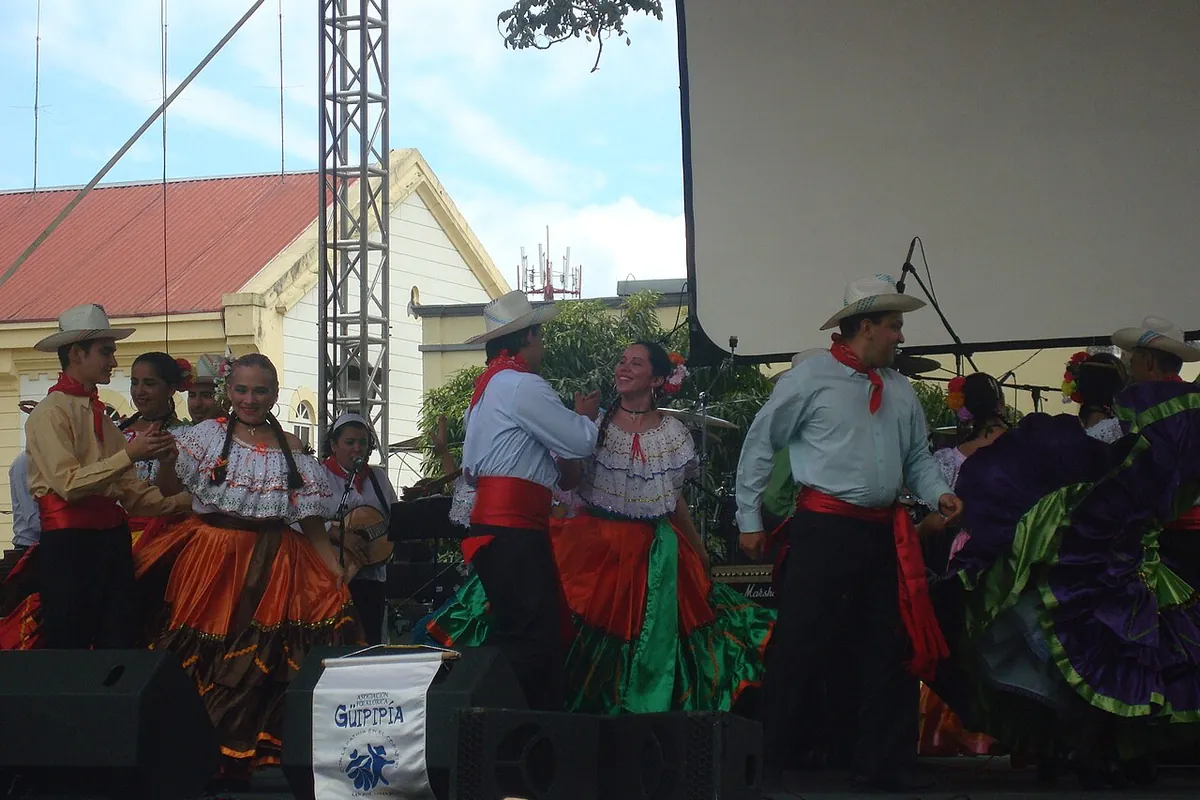
The punto guanacasteco is a courtship dance for couples, danced to marimba and guitar. Footprint Travel Guides describes it as a heel-and-toe dance and the typical national dance. Tico Travel says it has been the national dance since 1944, though anyone wanting the decree's own wording should check the Procuraduría General de la República or the Ministry of Culture.
Old name, young dance
The word guanacasteco ties the dance to Guanacaste, the north-western province that Wikipedia calls the major centre of Costa Rican folk music. The dance itself is younger than the region's reputation suggests. Footprint Travel Guides says it is not traditional in the folk sense but was composed, around 1900, by Leandro Cabalceta Brau, and Tico Travel also gives about 1900. A different travel site claims the 1830s, which shows how loosely such dates float in the tourism literature. When dates differ, the careful wording is that it dates from around 1900 on the better-sourced account.
The skirts and the sabanero
Costume does half the work. Tico Travel describes the women swinging wide, colourful skirts and the men in white with a straw hat and a red kerchief, dressed like a Guanacaste cowboy, or sabanero. The skirts are cut full so that they swing and flare as the dancer turns, and in a line of dancers the effect is a field of spinning colour.
The bomba
A distinctive touch is the bomba. Tico Travel says the music stops partway through and someone shouts "¡Bomba!" A dancer then recites a short rhyming verse, often a flirtatious jab at a partner or a joke about local life, before the music starts again. Bombas are in Spanish and depend on wordplay, so a guide's translation is a real help, and the booking page lists guides in English, Spanish, Portuguese and French. If a performance includes them, expect laughter from the Spanish speakers first.
Older dances behind the stage
Beneath the national dance lie older traditions. Wikipedia names the Danza del Sol and Danza de la Luna as pre-Columbian styles of the Chorotega, centred in Guanacaste, and the Danza de los Diablitos among the Boruca. Tico Travel calls the latter the Juego de los Diablitos, staged by the Boruca people, with men in carved wooden masks and a bull representing the Spanish conquerors, and says the sun and moon dances are performed mostly at cultural events today. In Nicoya, Tico Travel adds, the Yegüita is danced on 11 and 12 December during the Virgin of Guadalupe festival, to a drum and an ocarina.
What is staged and what is not
Footprint Travel Guides makes a blunt point: the botijuela, the tamborito and the cambute are not traditional and are staged for outsiders. That is a useful reminder that a folk dinner show is a performance for visitors, drawing on real music and costume without being a village festival. It does not make the evening worthless. It means you should enjoy it as a polished presentation, and look for the older rites at the festivals and cultural events where they are still held.
How to watch
Watch the skirts and the footwork, listen for the marimba's wooden tone and wait for the pause that signals a bomba. If the performers invite the audience to dance, the booking page does not say so, so do not count on it. The guided visit that the page lists may add context, and the guide can explain what the dancers are doing in the language you picked.
Frequently asked questions
Is the punto guanacasteco really the national dance?
Tico Travel gives 1944 as the year it became the national dance. Check the Procuraduría General de la República or the Ministry of Culture for the decree itself.
Will the show include audience dancing?
The booking page does not say. Treat it as a performance you watch, and ask in the booking page if participation matters to you.
Are the dances ancient?
The punto guanacasteco is not: Footprint Travel Guides says it was composed around 1900. The Chorotega and Boruca dances are far older.
Sources